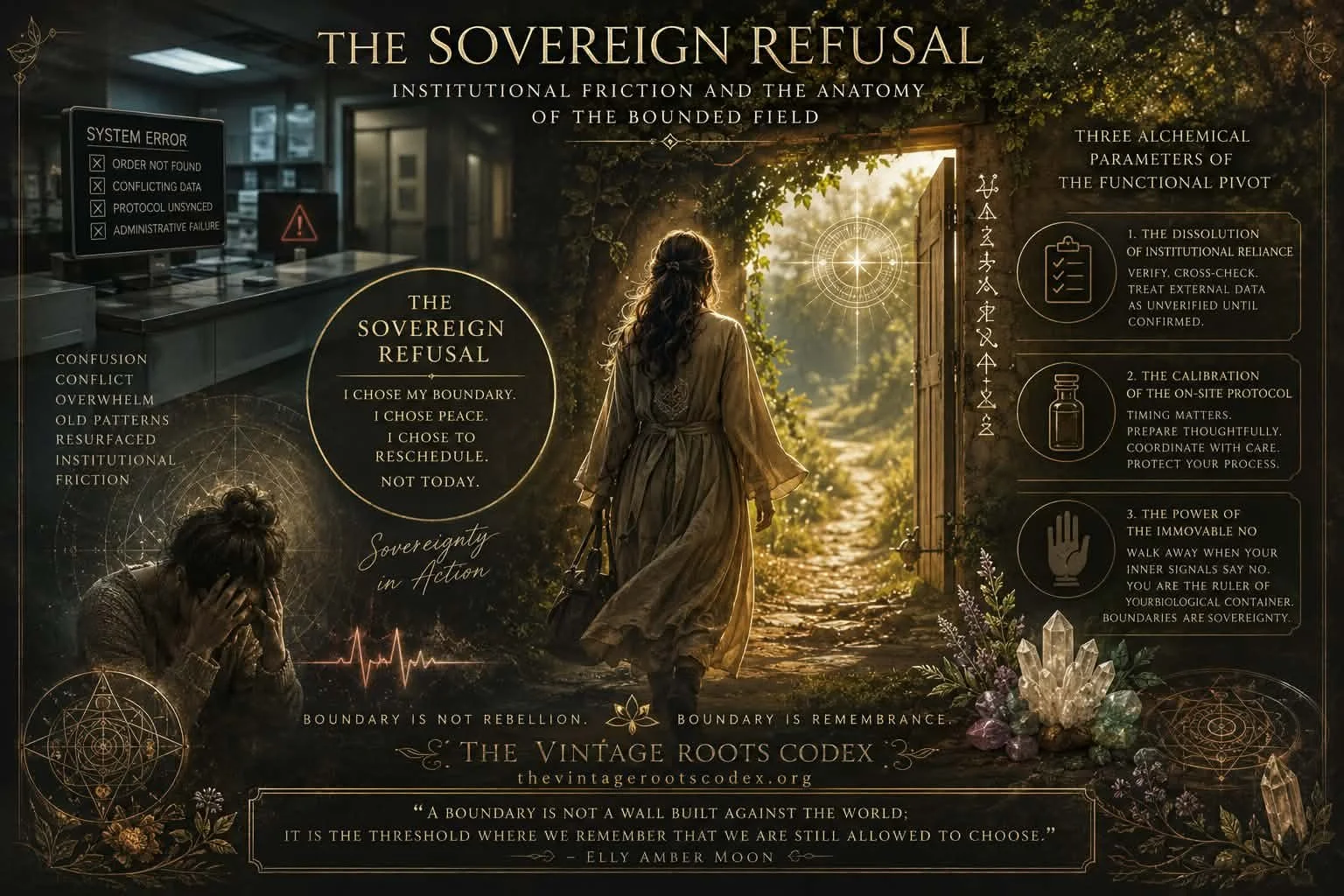
The Sovereign Refusal: Institutional Friction and the Anatomy of the Bounded Field
A personal field note on boundaries, institutional friction, and choosing to walk away
Today, I experienced something that reminded me exactly why personal boundaries matter—particularly when entering institutional environments where the individual can easily feel pressured to surrender their own internal signals for the sake of an external process.
There is an unspoken conditioning within modern society that institutional systems are supposed to function flawlessly. We arrive at a clinical, medical, or administrative facility assuming that the necessary orders have been entered, the information has been communicated, the protocols are synchronized, and every person involved has access to the same information.
But what happens when the system isn't synchronized?
What happens when an order is missing from the system, instructions conflict, information has not transferred correctly, or the people standing in front of you are operating from completely different pieces of information?
For me, the answer became very clear today:
I said no.
I chose not to override the signals I was receiving simply because an external timeline expected me to continue.
When Institutional Friction Becomes Personal
When an administrative or clinical process suddenly breaks down, the experience can feel much larger than the immediate inconvenience.
For someone carrying memories of previous medical stress, an unexpected disruption can activate old patterns of fear and physiological alarm. The body can respond before the conscious mind has even had time to process what is happening.
I felt that shift today.
The familiar internal response began to surface—the tightening, the rising sense of alarm, the feeling that my body was remembering something my conscious mind did not want to revisit.
I have come to understand these moments through the language of my own philosophical framework as a Negative Quantum Projection: an old pattern being projected into the present moment through an immediate experience of perceived threat or instability.
Whether one describes it through nervous-system language, emotional memory, trauma response, energetic philosophy, or simply the body's instinctive warning system, the practical lesson remains the same:
I do not have to remain inside an environment that no longer feels safe or properly coordinated simply because I have already arrived.
That realization changed everything.
The Sovereign Refusal
There is tremendous power in the word no.
Not an angry no.
Not a rebellious no.
Not a no designed to punish anyone.
A clear, calm, sovereign no.
Today, I chose to stop the process rather than force myself through an environment that had become increasingly uncomfortable and confusing.
I chose to reschedule.
That decision may appear insignificant from the outside.
For me, it wasn't.
It was an act of boundary preservation.
It was the recognition that changing the timeline is sometimes wiser than forcing the body to comply with a timeline created by someone else.
The moment I made that decision, something inside me shifted.
The pressure began to release.
I was no longer trying to make myself fit into a system that was not functioning correctly in that moment.
I simply stepped outside of it.
And that, to me, is sovereignty.
The Three Alchemical Parameters of the Functional Pivot
Today's experience revealed three important lessons that I want to carry forward.
1. The Dissolution of Institutional Reliance
One of the biggest lessons was recognizing how easily we can assume that external systems have already been checked and synchronized.
We assume the paperwork is correct.
We assume the orders are present.
We assume the digital records have transferred.
We assume everyone involved has received the same instructions.
But assumptions are not verification.
Moving forward, I intend to treat external administrative information as unverified until confirmed.
That means reviewing what can be reviewed before leaving home, asking questions when something does not match, and refusing to interpret confusion as something I simply need to tolerate.
The lesson isn't that institutions are inherently untrustworthy.
The lesson is that personal participation still requires personal verification.
2. The Calibration of the On-Site Protocol
Today's experience also showed me that timing matters.
When a personal health-related protocol depends upon a particular sequence of events, unexpected delays, transportation issues, administrative confusion, or changes at the facility can alter the circumstances surrounding that protocol.
That has led me to reconsider how I prepare for future appointments.
Rather than assuming everything will unfold according to schedule, I want the process to be structured around the actual environment in which it is taking place.
For me, that means discussing timing and medication-related logistics with the appropriate medical professionals beforehand and establishing a clear plan for what happens if the schedule changes.
The goal is not to control every variable.
The goal is to create enough clarity that I am not forced to make important decisions while already overwhelmed by an unstable environment.
Preparation becomes part of the boundary.
3. The Power of the Immovable No
And then there is the most important lesson.
The Immovable No.
The moment when you recognize that continuing is no longer the right decision for you—and you allow yourself to stop.
Not tomorrow.
Not after everyone else becomes comfortable.
Not after you have sufficiently explained yourself.
You simply stop.
There is no requirement to sacrifice your internal stability merely because other people have invested time into a process.
There is no requirement to remain in a room simply because you made an appointment.
There is no requirement to continue simply because you have already started.
Sometimes sovereignty looks like participation.
Sometimes sovereignty looks like cooperation.
And sometimes sovereignty looks like standing up, gathering your things, and saying:
“Not today.”
Walking away is not always failure.
Sometimes walking away is the most successful boundary you have ever established.
Today, I chose the boundary.
I chose the rescheduled timeline.
I chose to listen.
And I left knowing that protecting my peace was not an interruption of the process.
It was the process.
A Personal Reflection
I am learning that sovereignty does not mean believing I can control every external circumstance.
It means understanding that I can control my participation in circumstances that no longer align with what I need.
I cannot always control whether a system functions correctly.
I cannot control whether information is entered properly.
I cannot control whether another person understands what I am experiencing.
But I can control whether I remain.
And sometimes the most powerful act of self-preservation is not fighting the system at all.
It is simply refusing to participate until the conditions are right.
qas“A boundary is not a wall built against the world; it is the threshold where we remember that we are still allowed to choose.”
— Elly Amber Moon