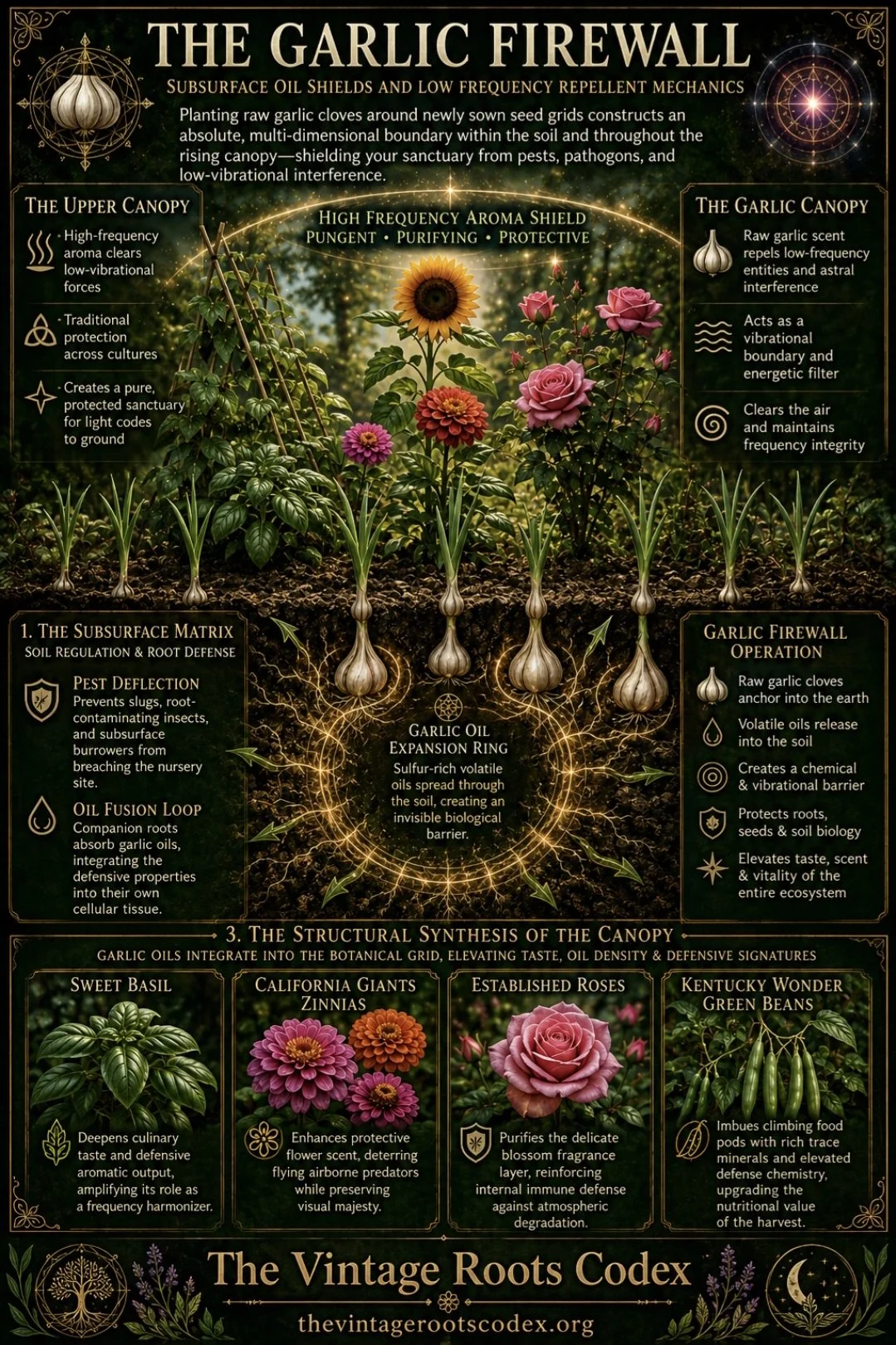
The Garlic Firewall: Subsurface Oil Shields and Low-Frequency Repellent Mechanics
Modern industrial frameworks have conditioned humanity to view agricultural landscapes as mechanical dirt patches. Under this low-vibrational corporate narrative, a garden becomes an extraction matrix requiring synthetic inputs, while the soil is reduced to passive material space.
When the human steward steps outside those institutional limitations and begins observing the unedited patterns of natural law, another kind of operational reality emerges.
While manually watering a freshly direct-sown landscape, I experienced a moment of deep stillness—a state in which observation became unusually receptive. The garden itself seemed to communicate through pattern, scent, moisture, placement, and timing.
One observation emerged with particular clarity:
Raw garlic cloves placed strategically around a newly sown seed grid can function as a botanical boundary—both physically within the soil and symbolically throughout the emerging canopy.
The chemistry of garlic provides one layer of this boundary. Its pungent sulfur-containing compounds are well known for their strong odor and biological activity, while traditional gardening practices have long incorporated aromatic plants into companion-planting and pest-management strategies.
Within the Codex, I refer to this layered boundary as The Garlic Firewall.
It is not merely a wall.
It is a living perimeter composed of soil chemistry, plant relationships, scent, observation, folklore, and the energetic language through which the gardener experiences the land.
🧄 1. The Subsurface Matrix: Soil Regulation & Root Defense
Beneath the topsoil, a raw garlic clove becomes an active biological presence.
As the clove encounters surrounding moisture, its tissues begin to break down and release characteristic sulfur-containing compounds responsible for garlic's intense aroma. This creates a localized chemical environment around the planted clove.
Within the Garlic Firewall model, this subterranean zone represents the first defensive layer.
Pest Deflection
Garlic's strong odor and sulfur chemistry can contribute to a less attractive environment for certain garden pests, although its effectiveness varies according to the pest species, concentration, weather, soil conditions, and placement.
For the land steward, the practical principle is simple:
Strategic aromatic planting creates another layer of biological diversity around vulnerable young plants.
Rather than relying upon a single intervention, the garden becomes a network of overlapping defenses.
The Oil-Fusion Loop
As companion plants develop their own root systems, they occupy the same living soil matrix as the garlic.
Pole beans, sunflowers, California Giants zinnias, sweet basil, roses, and other neighboring plants interact with the same moisture, microorganisms, minerals, organic matter, and atmospheric conditions.
The Codex interprets this interconnectedness as an Oil-Fusion Loop.
This does not mean that garlic oil literally transfers unchanged into the cellular tissue of every neighboring plant. Rather, it describes the larger ecological principle:
Plants do not exist as isolated objects.
Their roots, microorganisms, volatile compounds, physical proximity, pollinators, moisture, nutrients, and surrounding organisms form a continuously interacting system.
The Garlic Firewall therefore becomes a relationship rather than a single substance.
🌬️ 2. The Upward Canopy: Pungency, Folklore & Frequency Filtering
As garlic sends green shoots above the soil line, the boundary becomes visible.
Its characteristic scent moves from the subsurface environment into the surrounding air, creating another sensory layer within the garden.
The Traditional Timeline
Garlic has carried protective symbolism across numerous cultural traditions. It has historically been associated with protection, purification, household boundaries, food preservation, medicine, and the warding away of unwanted influences.
The Codex does not treat these traditions merely as superstition.
Instead, they are preserved as cultural memory—a record of how earlier peoples understood the relationship between aromatic plants, boundaries, protection, and the unseen world.
The Low-Frequency Repellent
Within the energetic language of The Vintage Roots Codex, the pungent garlic boundary becomes a form of frequency filtering.
The physical mechanism is scent.
The symbolic mechanism is protection.
The energetic interpretation is purification.
Together, these layers create the Garlic Firewall.
When the garden is experienced as a living sanctuary, the garlic perimeter becomes a reminder that boundaries can be biological, sensory, psychological, cultural, and energetic at the same time.
Rather than claiming that garlic physically repels invisible entities, the Codex records the deeper traditional interpretation:
What protects the garden physically can also become a symbol of protection energetically.
The boundary says:
This space is tended.
This space is intentional.
This space has a steward.
🍽️ 3. The Structural Synthesis of the Canopy
As the garden matures, the Garlic Firewall becomes part of a larger botanical architecture.
Each plant contributes its own scent, structure, flowering pattern, root behavior, food value, and relationship with surrounding organisms.
The result is not a single defensive plant.
It is a collective canopy.
Sweet Basil
Sweet basil contributes a powerful aromatic signature to the garden while serving as a culinary plant and companion within the broader planting system.
Within the Codex, basil represents the aromatic harmonizer—a plant whose fragrance becomes part of the garden's sensory architecture.
California Giants Zinnias
California Giants zinnias introduce height, color, and flowering abundance into the canopy.
Their primary role within this system is not to become an invisible shield, but to participate in the garden's visible ecological architecture by providing flowering resources and habitat for beneficial insects.
Within the Codex, their blossoms become the visual guardians of the canopy.
Established Roses
Established roses contribute another aromatic and structural layer.
Their fragrance, thorns, dense growth, and perennial presence create a natural threshold between cultivated spaces.
Within the Garlic Firewall model, roses represent the outer garden boundary—beauty and defense occupying the same structure.
Kentucky Wonder Green Beans
Kentucky Wonder green beans transform the defensive garden into a productive one.
Their climbing habit allows them to move vertically through the canopy, creating another structural dimension while producing food for the steward.
Within the Codex, the green bean represents the harvest layer:
the point where protection, cultivation, nourishment, and relationship with the Earth converge.
🧄 The Garlic Firewall Principle
The deeper lesson is not that one garlic clove creates an impenetrable supernatural barrier.
The deeper lesson is that intentional placement changes the architecture of a garden.
A garlic clove becomes one component.
The surrounding plants become another.
The soil becomes another.
The gardener's observation becomes another.
The scent becomes another.
The folklore becomes another.
The boundary emerges from all of them together.
This is the Garlic Firewall:
A living botanical perimeter created through strategic placement, aromatic chemistry, ecological relationships, traditional knowledge, and the steward's conscious relationship with the land.
The garden is not passive dirt.
It is an active system.
And when the steward begins listening closely enough to recognize its patterns, even something as ordinary as a garlic clove can become a doorway into a much larger understanding of how plants, soil, scent, structure, and human intention interact.
The firewall begins beneath the soil.
The canopy carries it upward.
The steward gives it intention.